
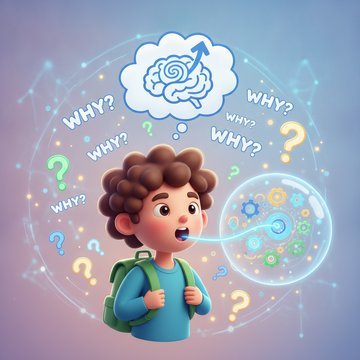



Elaborative interrogation is a study strategy where you ask "why is this true?" about each fact you're learning and then answer it in your own words. That simple act of forcing yourself to explain the reasoning behind a fact makes it far stickier in memory, because your brain has to connect the new information to things you already know instead of just parroting it back. Researchers have found it consistently beats passive rereading, and it works with almost no setup.
Content Table
What Elaborative Interrogation Actually Means
The technique boils down to one habit: whenever you read a fact, stop and ask "Why would that be the case?" Then you generate a plausible explanation yourself before checking whether you're right.
Say you read "Metals are good conductors of electricity." Instead of moving on, you pause and ask why. You answer: "Because metals have free electrons that can move around and carry charge." That extra 15 seconds of reasoning is the entire method.
The term comes from cognitive psychology research in the late 1980s. Studies by Bradley Seifert, Michael Pressley, and colleagues showed that students who generated "why" explanations for facts remembered significantly more than students who simply read the same facts or repeated them. It sits in the family of deep learning strategies that push you to process meaning rather than surface wording.
Why Asking "Why" Works
The reason comes down to how memory actually forms. Isolated facts have nothing to hook onto, so they fade fast. When you explain why something is true, you build connections between the new fact and your existing knowledge, and those connections become retrieval routes later.
- It forces active processing. You can't answer "why" by skimming. Your brain has to search for related knowledge and assemble an explanation.
- It exposes gaps. If you can't explain why a fact is true, you've just discovered you don't really understand it. That's useful feedback rereading never gives you.
- It creates meaningful learning. Facts that fit into a web of reasons are easier to recall than facts floating alone, which is the core of genuine comprehension improvement.
This is closely tied to the generation effect, which shows that information you produce yourself is remembered better than information you simply read. Elaborative interrogation is basically the generation effect aimed at reasons.
How to Use It Step by Step
- Read one fact or claim. Keep the chunk small, a single sentence or idea works best.
- Ask "Why is this true?" or "Why does this make sense?" out loud or on paper.
- Answer in your own words before looking anything up. Guessing is fine.
- Check your explanation against the text or a trusted source, and fix it if you were off.
- Move to the next fact and repeat.
It pairs well with other evidence-based methods. Turn your best "why" answers into cards and review them with spaced repetition so the connections keep strengthening over time. If your attention drifts during the reasoning step, a quick look at why your brain wanders and how to fix it can help you stay with each question long enough to answer it.
Real Examples Across Subjects
| Fact | Your "why" question and answer |
|---|---|
| Warm air rises. | Why? Because warm air is less dense than cool air, so it floats upward like a bubble. |
| The 2008 financial crisis spread globally. | Why? Because banks worldwide held connected mortgage-backed assets, so failures in one market rippled into others. |
| Spanish adjectives usually follow the noun. | Why? Because the language's structure emphasizes the noun first, unlike English which front-loads the adjective. |
| Exercise improves memory. | Why? Because it increases blood flow and growth factors that support new connections in the brain. |
Notice the method shines brightest for factual material that has an underlying logic. It works well in biology, history, economics, and languages, where nearly every fact has a "because" waiting behind it. This kind of reasoning also strengthens transfer of learning, because understanding the mechanism behind a fact makes it easier to apply that idea in a new context.
Where It Falls Short
- Arbitrary facts. Asking "why" about something with no real reason, like a random vocabulary word's spelling or a phone number, gives you nothing to reason about. Pair those with flashcards and repetition instead.
- Weak background knowledge. If you know almost nothing about a topic, you'll struggle to generate useful explanations. The technique rewards people who already have some hooks to connect to.
- Time cost. It's slower than rereading per fact, though the payoff in retention usually makes it worth it.
For learning that leans heavily on visuals, combine it with dual coding theory, pairing your verbal explanation with a diagram so the idea gets stored two ways.
Elaborative Interrogation vs Self-Explanation
People mix these up, and they are close cousins. The difference is scope:
- Elaborative interrogation targets a specific fact and asks "why is this true?"
- Self-explanation is broader. You explain how you're thinking through a whole process, problem, or passage, including your own steps and confusions.
Both belong to the same toolbox of learning through inquiry, and you can use them together. A 2013 review in Psychological Science in the Public Interest by John Dunlosky and colleagues rated both as promising, moderate-utility techniques, ahead of highlighting and rereading. You can read the full Dunlosky review here if you want the underlying data.

Turn your "why" answers into cards you'll actually remember
Once you've used elaborative interrogation to explain why a fact is true, save that explanation as a flashcard and review it over time so the reasoning sticks for good.
Create your flashcards →
Frequently Asked Questions
Not at first. The memory benefit comes from the act of reasoning, so even a plausible guess helps. That said, you should always check your explanation afterward and correct it, because storing an accurate reason is more useful than storing a wrong one long term.
Rereading is passive; your eyes move but your brain often coasts. Elaborative interrogation forces you to generate something new, which exposes gaps and builds connections rereading never creates. Studies consistently show the "why" method produces stronger recall than repeated reading of the same material.
Anything with underlying cause and effect: biology, history, economics, psychology, and the grammar rules in language learning. These subjects have a "because" behind almost every fact. It works less well for truly arbitrary information like isolated dates, spellings, or random numbers.
You'll notice better recall almost immediately, often within a single study session compared to rereading. The bigger advantage shows up on delayed tests days or weeks later, where the connections you built keep the information accessible while passively read facts fade.
Yes, and you should. Pair it with spaced repetition to keep reviewing your explanations, with dual coding to add diagrams, and with self-explanation for whole processes. Elaborative interrogation slots neatly into almost any study routine without needing special tools.