


If you've ever sat down to study and found your mind drifting to random thoughts, your phone, or literally anything else within minutes, you're dealing with one of the most common struggles in learning: figuring out how to focus while studying in a world designed to pull your attention in every direction. The good news is that poor focus isn't a personality flaw. It's a predictable result of how your brain actually works, and once you understand the mechanics, you can fix it with specific, practical strategies.
Content Table
Why Your Brain Wanders During Study
Your brain has two competing networks that are constantly fighting for control. The task-positive network activates when you're focused on something specific, like reading a textbook or solving a problem. The default mode network (DMN) takes over when your mind isn't actively engaged, producing daydreams, memories, and random thoughts. Researchers at Dartmouth College have found that the DMN is incredibly active and doesn't just quietly wait in the background. It actively competes with your focused attention.
When your study material is too easy, too hard, or not connected to something you care about, your brain interprets it as low-priority and hands the wheel to the DMN. Add in a notification ping or a noise from another room, and the switch happens almost instantly.
The Hidden Cost of Context Switching
Every time you switch from studying to checking a message, scrolling social media, or even just glancing at a notification, you pay a cognitive tax. Researcher Sophie Leroy coined this attention residue: part of your brain stays mentally stuck on the previous task even after you've physically moved to the next one.
This is why you can sit back down after "just a quick check" of your phone and feel like you have to warm up your brain all over again. You're not imagining it. The residue from Task A (Instagram, a text conversation, a YouTube clip) lingers and degrades your performance on Task B (studying) for several minutes afterward.
Context switching doesn't just waste time. It degrades the quality of the work you do when you return. A study session interrupted five times isn't equivalent to a solid uninterrupted session of the same total duration. The interrupted session produces shallower processing and weaker memory encoding.
How to Eliminate Distractions at Home and Elsewhere
Distractions at home are uniquely brutal because you control almost none of the environmental cues. Other people, ambient noise, the fridge, your gaming setup, your bed, all of it competes for your attention. Here's how to systematically reduce the interference:
Phone and Digital Distractions
- Put your phone in another room, not just face-down on the desk. Research from the University of Chicago found that even the mere presence of a smartphone on a desk reduces available cognitive capacity, even when it's silent and flipped over.
- Use website blockers like Freedom or Cold Turkey during study blocks to prevent impulsive tab-switching.
- Turn off all non-essential notifications before you sit down, not just during a session. The habit of checking notifications trains your brain to expect interruptions.
Noise and People
- Noise-canceling headphones are one of the highest-ROI purchases for students who study at home or in shared spaces.
- Brown noise or white noise (available on YouTube or apps like myNoise) can mask unpredictable ambient sounds without being distracting themselves.
- Communicate your study schedule to housemates or family members so they know when not to interrupt.
Internal Distractions
- Keep a "distraction notepad" next to you. When a random thought pops up ("I need to reply to that email"), write it down and immediately return to studying. You've captured it, so your brain can let go of it.
- If you're hungry, tired, or anxious, no productivity technique will fully compensate. Address the physical need first.
Concentration Techniques That Actually Work
The techniques below are grounded in cognitive science, not motivational fluff. Each one targets a specific mechanism behind focus improvement.
The Pomodoro Technique
Work for 25 minutes, then take a 5-minute break. After four cycles, take a longer 15-30 minute break. This works because it gives your brain a defined endpoint, which reduces the psychological weight of a long study session. Knowing a break is coming in 18 minutes makes it easier to resist distractions right now. You can use a Pomodoro timer to structure your sessions without having to manage the clock yourself.
Active Recall Over Passive Re-reading
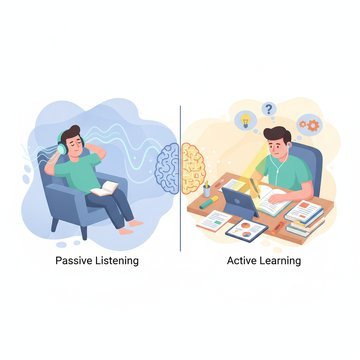
Passive re-reading feels productive but produces very little learning. Active recall, where you close your notes and try to retrieve information from memory, forces deeper processing and keeps your attention engaged because there's a real cognitive challenge involved. Tools like digital flashcards are built specifically for this kind of retrieval practice.
Implementation Intentions
Instead of vaguely planning to "study chemistry later," write: "I will study Chapter 4 of my chemistry textbook at 3pm at my desk for 45 minutes." This specific format (when, where, what) dramatically increases follow-through, according to research by psychologist Peter Gollwitzer. The specificity removes the decision-making overhead that often leads to procrastination.
Interleaving
Interleaving means mixing different subjects or problem types within a single session instead of blocking all of one subject together. It feels harder, and that is the point: your brain can't go on autopilot, so your attention stays engaged.
Building Deep Work Into Your Routine
Cal Newport's concept of deep work describes cognitively demanding tasks performed in a state of distraction-free concentration. For students, this means study sessions where you're genuinely pushing your understanding, not just going through the motions.
Deep work is a skill that degrades if you don't practice it. If you've spent months consuming content in short bursts (TikTok, YouTube shorts, quick news headlines), your sustained attention capacity has likely shrunk. You can rebuild it, but it takes deliberate practice.
Practical steps to build deep work capacity:
- Start small. If 25 minutes feels impossible, start with 10 and add 5 minutes each week.
- Schedule it at the same time each day. Routine reduces the friction of starting.
- Track your sessions. A simple log of "I completed a 40-minute focused session today" builds momentum and makes the habit feel real.
- Protect your peak hours. Most people have a 2-4 hour window of peak cognitive performance, usually in the morning. Guard that time for your hardest material.
For language learners specifically, deep work pairs exceptionally well with spaced repetition. If you're curious how flashcards fit into a serious study system, read more about why flashcards dominate language learning and how to use them effectively.
The Focus-Sleep Connection You Can't Ignore
No concentration technique makes up for a short night, because the prefrontal cortex, the part of your brain responsible for sustained attention and impulse control, is one of the first regions to suffer when you're under-slept. The next day you'll have more attention lapses and a harder time resisting distractions, so protect your sleep before adding new study techniques, and read more about how lack of sleep affects memory.

Stop drifting. Start your next focused study block right now.
If you're working on how to focus while studying, a structured timer removes the mental overhead of watching the clock. Use our free Pomodoro timer to break your sessions into focused work blocks with built-in breaks, so you can stop negotiating with yourself and just start.
Try the Free Pomodoro Timer →
Most people notice meaningful improvement within 2-4 weeks of consistent practice, starting with shorter focused blocks (10-15 minutes) and gradually extending them. The brain's capacity for sustained attention responds to deliberate training similarly to physical fitness. You won't go from 5-minute attention spans to 2-hour deep work sessions overnight, but steady progress is very achievable with daily practice.
It depends on the task and the person. For complex tasks requiring working memory (math, writing, problem-solving), silence or non-lyrical ambient sound tends to be better. Lyrics compete directly with language-processing regions of the brain. For repetitive or simpler tasks like flashcard review, familiar background music can improve mood without hurting performance. Experiment and track which setup produces better results for you specifically.
Deadlines trigger a stress response that releases norepinephrine and dopamine, both of which sharpen attention and motivation in the short term. The problem is this state is unsustainable and doesn't produce the deep processing needed for long-term retention. Implementation intentions (scheduling specific study tasks like appointments) and the Pomodoro Technique simulate some of that urgency without the cortisol spike of a real deadline.
Many of the same strategies help, but people with ADHD typically need more structure, shorter work blocks, stronger environmental controls, and often professional support (therapy, medication, or both) to see consistent results. The Pomodoro Technique, body doubling (studying alongside another person), and removing all digital distractions tend to be especially effective. If you suspect ADHD, a formal evaluation is worth pursuing rather than relying solely on productivity hacks.
Research on expert performers suggests 4-5 hours of genuinely focused deep work per day is close to the sustainable ceiling for most people. Beyond that, cognitive performance degrades and the quality of study drops significantly. Most students overestimate how much of their "study time" is actually focused, and underestimate how much of it is distracted low-effort work. Four high-quality hours consistently beats eight hours of scattered, interrupted studying.
First, check the basics: are you sleep-deprived, hungry, or anxious about something unrelated to studying? If so, address those first. If not, try switching to active recall instead of passive reading, since your brain needs a real challenge to stay engaged. You can also try the "5 more minutes" rule: when you want to quit or drift, commit to just 5 more focused minutes. Often, momentum carries you through the rough patch.