

Your motivation to study keeps dropping because motivation was never a fuel tank you fill up in the morning. It is a signal your brain produces in response to three things: how much effort a task currently costs you, how clearly you can see progress, and whether you expect the next 30 minutes to actually pay off. When any of those three slip, the signal fades, and it feels like laziness even though it is really a prediction problem plus accumulated cognitive fatigue.
That distinction matters, because most advice treats the fading as a character flaw. It usually is not. Below is what is actually happening inside each common motivation crash, and what changes it.
Content Table
- Motivation follows action, not the other way around
- Cognitive fatigue is not the same as being tired
- Your brain stopped expecting a payoff
- Procrastination is mood repair, not laziness
- How grades quietly erode intrinsic motivation
- The invisible progress problem
- Diagnose which kind of drop you are having
- What actually rebuilds study consistency
Motivation follows action, not the other way around
Most people wait to feel ready. But the feeling of wanting to study is largely generated after you start, once your brain registers that the task is underway and not as bad as predicted.
Before you start, your brain is running a rough cost estimate: how hard, how long, how likely to go badly. That estimate is almost always inflated, because unstarted tasks have no shape. A vague "study biology" has infinite perceived size. "Answer the 12 questions at the end of chapter 4" has a known edge.
This is why the first five minutes feel disproportionately heavy and why they get lighter fast. The task shrinks the moment it becomes concrete.
Cognitive fatigue is not the same as being tired
Cognitive fatigue is a specific state: your ability to hold and manipulate information drops, error rates climb, and effort starts to feel aversive even though your body is fine. You can be physically rested and mentally fried at the same time.
Signs you are fatigued rather than unmotivated:
- You reread the same paragraph three times and retain nothing.
- You can still scroll, chat, or watch video without difficulty, but structured thinking feels sticky.
- Simple decisions (which chapter, which problem set) feel oddly hard.
- You get irritable when interrupted, not just bored.
Two things make it worse. The first is context switching. Every time you jump from notes to phone to a different subject, you pay a reload cost, and that cost compounds across an evening. If your sessions are constantly fragmented, the problem may be attention rather than drive, which is a different fix than motivation. Our breakdown of why your brain wanders while studying covers what is happening there.
The second is sleep. Sleep debt does not just make you sleepy, it degrades the consolidation process that turns today's studying into tomorrow's knowledge, so you work harder for less return. See how sleep consolidates what you learn for the mechanism.
Your brain stopped expecting a payoff
Dopamine is often described as a pleasure chemical, but in learning it works more like a prediction system. It rises when an outcome is better than expected and falls when the expected reward stops arriving. Effort you believe will pay off feels energising. Effort you believe is pointless feels like dragging furniture.
Studying is unusually bad at delivering feedback. You read for two hours and receive nothing: no score, no signal, no confirmation. Your brain has no evidence the effort worked, so it lowers the expected value of the next session. That is the quiet reason motivation and learning decouple over a long semester.
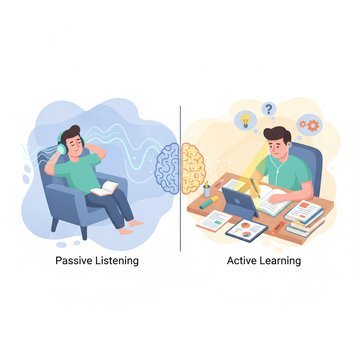
Worse, passive methods create a false signal in the wrong direction. Rereading and highlighting feel smooth, so you feel competent while learning very little, then the test disproves it and your confidence drops hard. That mismatch is the illusion of fluency, and it is a reliable motivation killer because the payoff never matches the predicted one.
Active methods (self-testing, explaining out loud, writing answers from memory) feel harder but return immediate feedback. Harder and informative beats smooth and silent, every time.
Procrastination is mood repair, not laziness
Research on procrastination consistently points to short-term mood regulation rather than poor time management (Sirois & Pychyl, 2013). You are not avoiding the work. You are avoiding a feeling the work produces: boredom, anxiety about being bad at it, resentment, or the discomfort of not knowing where to start.
The giveaway is what you do instead. People rarely procrastinate into nothing. They procrastinate into something that reliably feels okay: cleaning, messaging, a "quick" video. The behaviour is not random, it is targeted relief.
Which means the fix is emotional, not logistical:
- Name the feeling first. "This chapter makes me feel stupid" is actionable. "I'm lazy" is not.
- Lower the stakes of starting. Permission to do a bad, messy first pass removes the anxiety trigger.
- Separate deciding from doing. Choose tomorrow's exact task tonight, so the anxious moment of choosing does not sit in front of the work.
- Forgive the last time. Self-blame after procrastinating increases the odds you avoid the task again, because the task is now linked to shame.
Your emotional state while working also shapes what you retain, not just whether you show up. That link is explained in how your emotional state while studying affects what you remember.
How grades quietly erode intrinsic motivation
Self-determination theory describes three needs that keep motivation alive: autonomy (I chose this), competence (I am getting better), and relatedness (this connects to people or purposes I care about). Strip any of them and drive fades.
School strips autonomy by design. Fixed syllabus, fixed deadlines, fixed assessment. When an activity you once found interesting becomes purely instrumental, the overjustification effect can kick in: the external reward replaces the internal reason, and when the reward is distant (a grade in six weeks), there is nothing left pulling you forward (Lepper, Greene & Nisbett, 1973; Deci, Koestner & Ryan, 1999 meta-analysis).
You can restore small amounts of autonomy without changing your course:
- Choose the order you cover topics, even when you cannot choose the topics.
- Choose the format: flashcards, a mind map, a written explanation, a practice test you build yourself.
- Attach one genuine curiosity question per session ("why does this reaction actually go that direction?").
- Set your own sub-deadline earlier than the official one, so the deadline is yours.
Intrinsic motivation rarely returns as passion. It returns as mild interest plus a sense of control, and that is enough.
The invisible progress problem
Competence needs evidence. If you cannot see improvement, your brain treats the effort as wasted, no matter how much you did.
Studying hides progress in a specific way: forgetting happens fast and silently, so a week later you feel like you are starting over. You are not, but it feels that way, and the feeling is what drives motivation. Understanding why you forget things so quickly after studying reframes those blank moments as normal decay instead of proof you are bad at this.
Make progress visible with concrete markers:
- Track cards or questions answered correctly without help, not hours studied.
- Keep a one-line log per session: what you could not do before and can do now.
- Retake an old quiz cold every two weeks. Seeing an old score beaten is direct reward evidence.
- Note the questions you still get wrong. A shrinking error list is progress you can point at.
Thinking about your own learning this way, checking what you actually know rather than what feels familiar, is a skill in itself. Here is what metacognition actually does to your learning.
Diagnose which kind of drop you are having
Different causes need opposite responses. Pushing harder when you are cognitively fatigued makes things worse. Resting when the real issue is a vague task makes things worse too.
| What it feels like | What is likely happening | What actually helps |
|---|---|---|
| Fine until I open the book, then I want to leave | Anticipated effort is inflated because the task is undefined | Define one 10 minute unit with a clear end point and start it |
| Reading but nothing goes in | Cognitive fatigue or sleep debt | Stop, sleep, or switch to low-load review. More hours will not help |
| I study a lot but scores do not move | Passive methods with no feedback loop | Self-testing, practice questions, explaining without notes |
| I keep swapping to my phone | Context switching and mood repair | Phone in another room, single task per block, name the avoided feeling |
| I do not care about any of this anymore | Autonomy and purpose have drained out | Choose format and order yourself, add one curiosity question per session |
| Every session feels like starting from zero | Normal forgetting plus no visible progress markers | Track recall scores over time, retake old material cold |
What actually rebuilds study consistency
Study consistency is what replaces motivation once you accept that motivation is unreliable by design. The goal is to lower the activation cost so much that a bad-mood day still produces something.
- Fix the start time, not the duration. Same time, same place. Each repeat removes a little more of the daily decision.
- Set a floor, not a target. A floor of 15 minutes you never skip beats a target of two hours you hit twice a week. On good days you overshoot naturally.
- Prepare the task the night before. Materials open, exact page chosen. Future you meets a task, not a decision.
- End mid-task on purpose. Stopping with an obvious next step makes re-entry far easier the next day.
- Build in feedback every session. Even five self-test questions gives your brain the payoff signal it needs to keep predicting value.
- Protect sleep before extending study hours. An extra hour awake at midnight costs more than it adds.
One last reframe. A drop in motivation after a long stretch of studying is not a malfunction. It is your brain telling you the current approach costs more than it returns. Change the cost or change the return, and the signal comes back.

Give Your Studying the Feedback Loop It Is Missing
Motivation to study drops fastest when you cannot see progress. Turn your notes into a quiz or flashcards in Eduloo, so every session ends with a visible score instead of a vague feeling.
Create Your Quiz →
Frequently Asked Questions
Two effects stack up. Cognitive fatigue accumulates from weeks of sustained effort, and the initial novelty reward fades once the material stops feeling new. Meanwhile the payoff (exams, grades) is still far away, so your brain lowers its expected return on each study session.
Normal fatigue lifts after a good night of sleep or a rest day, and you still enjoy other activities. Burnout persists for weeks, spreads into things you used to enjoy, and comes with cynicism about the whole course. If low mood lasts beyond two weeks, talk to a doctor or counsellor.
Drop the target to something almost insultingly small: ten minutes, five questions, one page summarised from memory. Starting generates the motivation you were waiting for. If you genuinely cannot focus after ten minutes, that is fatigue, and rest is the productive choice.
Rewards for simply showing up can crowd out internal interest over time, especially for tasks you already liked. Rewards tied to real progress, such as beating a previous quiz score, work better because they act as feedback about competence rather than as payment for compliance.
Important tasks carry higher emotional stakes, so avoiding them delivers stronger short-term relief. The fear of doing it badly attaches to the work itself, and your brain treats avoidance as the solution. Reducing the stakes of the first attempt breaks that loop faster than willpower does.
Habit research at University College London (Lally et al., 2009) found an average of about 66 days, with a range from roughly three weeks to eight months depending on the person and the habit. Expect it to feel effortful at first. What changes earliest is the decision cost: once the time, place and first task are fixed, you stop negotiating with yourself, and that alone removes most of the daily friction.