
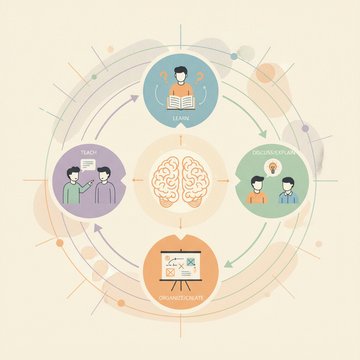
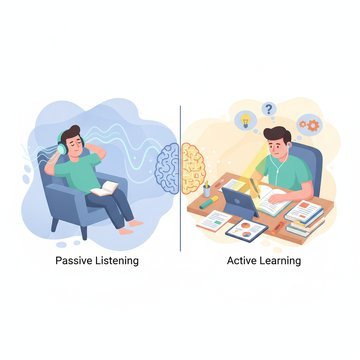

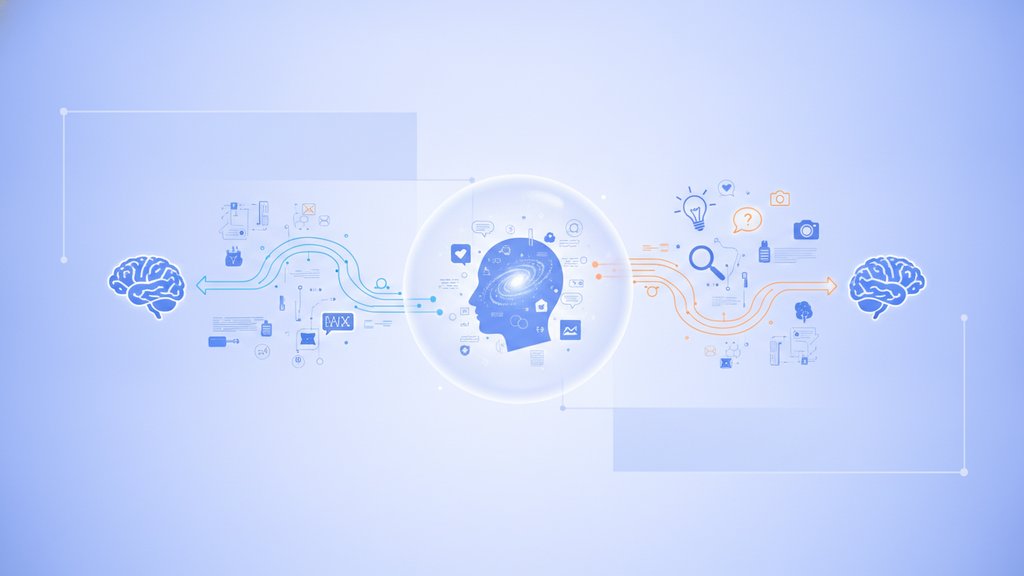
Dual coding theory explains why combining words with images leads to stronger memory than using either format alone. Proposed by psychologist Allan Paivio in the 1970s, the theory argues that the brain processes verbal and visual information through two separate but connected channels, and activating both at once creates a richer, more durable memory trace. In practical terms, that's why a diagram next to a paragraph sticks with you far longer than the paragraph by itself.
Content Table
Where Paivio's Theory Came From
Allan Paivio, a cognitive psychologist at the University of Western Ontario, published the foundational work on dual coding in his 1971 book Imagery and Verbal Processes . His research started with a simple observation: people remember concrete nouns like "apple" or "bicycle" far better than abstract ones like "justice" or "concept." The reason, he argued, was that concrete words automatically trigger a mental image in addition to a word-label, giving the brain two hooks instead of one.
Paivio's dual coding model was a direct challenge to the dominant view at the time, which treated all memory as a single, unified system. His experiments showed that imagery and language are genuinely separate cognitive systems that can operate independently but also reinforce each other. Decades of follow-up research have broadly supported his framework, and it now sits at the foundation of how educators and cognitive scientists think about visual verbal learning.
The Two Coding Channels Explained
Dual coding theory identifies two distinct mental systems:
- The verbal system handles language: words, sentences, internal monologue, and anything you read or hear as speech. It processes information sequentially, one word or phrase at a time.
- The nonverbal (imagery) system handles mental pictures, spatial relationships, and sensory impressions. It processes information more simultaneously, taking in a whole scene or diagram at once.
These two systems are linked by what Paivio called "referential connections." When you read the word "dog," your verbal system processes the word, but a referential connection can fire up the imagery system to produce a mental picture of a dog at the same time. The more automatically those connections activate, the more memorable the concept becomes.
Critically, the two systems store information independently. If one retrieval path fails, the other can still work. That redundancy is a big part of why dual-coded memories are more resilient than single-coded ones.
Why Images Boost Memory
The memory advantage of pairing images with words comes down to three mechanisms:
- Dual encoding: The same concept gets stored in two separate formats, so there are two potential retrieval routes instead of one.
- Referential connections: Links between the verbal and imagery systems mean that recalling one (seeing the word) can cue the other (the mental image), and vice versa.
- Distinctiveness: A concrete, vivid image is more distinctive in memory than an abstract verbal description, making it less likely to get confused with other stored information.
Research consistently shows that illustrated text outperforms text alone on recall tests. A widely cited meta-analysis of Paivio's imagery retention research found that concrete, image-evoking words are recalled roughly twice as often as abstract words under equivalent study conditions. That's not a marginal effect; it's a dramatic difference that holds up across ages and subject areas.
Multimodal Learning Examples in Practice
Dual coding isn't just a lab phenomenon. It shows up in everyday learning contexts all the time:
- Annotated diagrams in science textbooks: A labeled diagram of the human heart activates both the verbal labels and the spatial image of the organ simultaneously, which is why students remember it better than a paragraph description alone.
- Flashcards with pictures: Adding an image to a vocabulary flashcard gives learners a visual anchor. This is one reason flashcards are so effective for language learning, especially when they include illustrations or photos alongside the target word.
- Infographics: A well-designed infographic pairs data with visual metaphors, letting the viewer encode statistics through both the number (verbal) and the visual representation (chart, icon, proportional graphic).
- Mind maps: Arranging concepts spatially on a page creates a visual structure that the imagery system can encode, while the words on each node engage the verbal system.
- Gesture and speech in lectures: When a teacher gestures while explaining (pointing to a map, miming a process), students encode both the spoken words and the physical action, engaging multimodal memory traces.
Dual Coding in Early Childhood Education
Multimodal learning in early childhood is practically built into how young children naturally learn. Before they can read fluently, children rely heavily on pictures, physical objects, and gestures to build conceptual understanding. Dual coding theory gives a cognitive explanation for why picture books work so well: the illustrations and the read-aloud text activate both systems together, creating stronger concept representations than either alone.
Specific practices that apply dual coding in early childhood settings include:
- Picture-word walls: Classroom word walls that pair each word with a corresponding image rather than just listing vocabulary terms.
- Storyboard retelling: Children draw scenes from a story they heard, converting verbal input into imagery output and reinforcing both codes.
- Manipulatives in math: Physical blocks or counters give a spatial, visual representation of number concepts alongside the spoken or written numeral.
- Action songs: Songs paired with physical movements (like "Head, Shoulders, Knees and Toes") link verbal labels to body-based imagery, which is why children remember them so reliably.
Research in early literacy consistently shows that children who receive instruction combining images and language develop stronger vocabulary and comprehension than those receiving text-only instruction. The Reading Rockets project at WETA summarizes several of these classroom applications well.
Encoding Strategies That Apply Dual Coding
You don't need a teacher or a textbook to apply dual coding. These are strategies any learner can use independently:
- Sketch-noting: While reading or listening, draw small doodles or icons next to written notes. The drawings don't need to be good; they just need to activate the imagery channel.
- Create mental movies: When reading abstract material, deliberately visualize a scene that represents the concept. For example, picturing supply and demand as two people tugging a rope helps encode an economics concept visually.
- Use image-paired flashcards: Add a photo, drawing, or even a simple symbol to every card you study. This is especially effective for foreign language vocabulary and scientific terminology.
- Draw process diagrams: After reading a multi-step process, close the book and draw it as a flowchart from memory. The act of converting verbal information into a visual format deepens encoding.
- Annotate images: When studying a diagram, add your own labels in your own words. This forces both systems to engage with the same content.
Sleep is also a critical part of the encoding process. Both verbal and visual memory traces get consolidated during sleep, which means that studying with dual coding strategies right before sleep can amplify their effect. If you want to understand exactly how that consolidation works, the article on how sleep consolidates what you learn covers the neuroscience in detail.
Dual Coding vs. Multimedia Learning Theory
Dual coding theory is often mentioned alongside Richard Mayer's multimedia learning theory, and the two are related but not identical. Here's how they compare:
| Feature | Dual Coding Theory (Paivio) | Multimedia Learning Theory (Mayer) |
|---|---|---|
| Origin | Allan Paivio, 1971 | Richard Mayer, 1990s-2000s |
| Core claim | Verbal and imagery systems are separate; activating both improves memory | People learn better from words and pictures than from words alone |
| Focus | Memory encoding and long-term retention | Instructional design and working memory load |
| Key distinction | Two independent storage systems with referential links | Auditory and visual channels with limited capacity each |
| Practical application | Imagery-based study strategies, concrete vocabulary | Slide design, e-learning, animation + narration |
Mayer explicitly built on Paivio's work, and his Cambridge Handbook of Multimedia Learning cites dual coding as a foundational framework. The key practical difference is that multimedia learning theory adds the idea of cognitive load: you can overload a learner with too many visuals or too much simultaneous auditory and visual information, so design matters. Dual coding tells you to use both channels; multimedia learning theory tells you how to do it without overwhelming working memory.

Put dual coding theory to work in your flashcard reviews
Dual coding theory shows that pairing a word with an image creates two memory traces instead of one. Import Anki decks that already include images, or pair each word with a mental image while you review.
Create Flashcards →
Dual coding theory says the brain has two separate systems for storing information: one for language and one for mental images. When you learn something using both a word and a picture together, both systems encode it, giving you two retrieval routes instead of one. That's why illustrated explanations are easier to remember than plain text alone.
Allan Paivio, a Canadian cognitive psychologist at the University of Western Ontario, developed dual coding theory and published the foundational framework in his 1971 book Imagery and Verbal Processes . He continued refining the model through the 1980s and 1990s, with a major update in his 1990 book Mental Representations: A Dual Coding Approach .
Yes, it has substantial empirical support. Decades of memory experiments show that concrete, image-evoking words are recalled significantly more often than abstract words, and that adding relevant images to text improves learning outcomes. The theory has been replicated across age groups, languages, and subject areas, though some researchers debate the exact mechanisms Paivio proposed.
Learning styles theory claims that individuals have a fixed preferred modality (visual, auditory, kinesthetic) and learn best when taught in that style. That claim is not well supported by research. Dual coding theory makes a different and better-supported claim: that everyone benefits from combining verbal and visual information, regardless of any individual preference. It's a universal cognitive principle, not a personal trait.
Absolutely. Digital flashcards with images, annotated slides, explainer videos that pair narration with on-screen visuals, and infographics all apply dual coding principles. The key is that the image and the verbal content should refer to the same concept, not just decorate the page. Irrelevant images don't help and can actually distract from encoding.
Concrete topics with clear visual representations benefit most: anatomy, geography, chemistry, foreign language vocabulary, historical timelines, and mechanical processes. Abstract topics like philosophy or pure mathematics are harder to visualize, but even there, metaphorical diagrams and analogies can engage the imagery system to some degree and improve retention over text alone.