
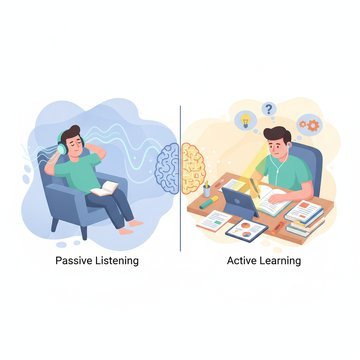


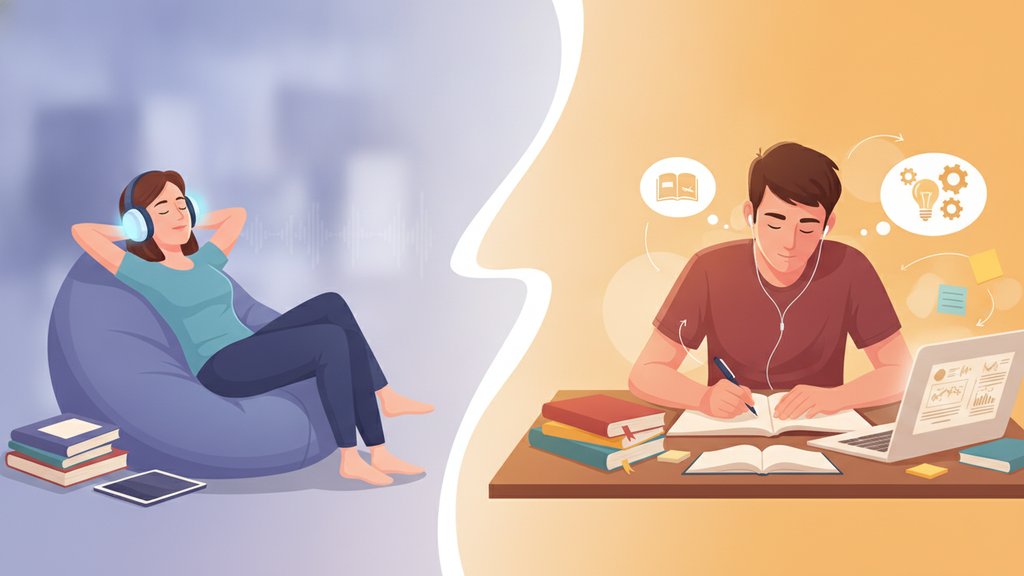
Passive listening is when audio plays in the background while your attention is somewhere else, like scrolling your phone or doing chores, and your brain only half-registers what's being said. It often feels productive because you're "consuming" a lecture or podcast, but for actual learning and memory it's one of the weakest study methods available. The reason is simple: real learning requires your brain to work, and passive listening lets it coast.
Content Table
What passive listening actually is
Passive listening means audio is entering your ears without your full, focused attention on it. You hear the words, but you're not processing them deeply, questioning them, or trying to hold onto them. Common examples:
- Playing a recorded lecture while you scroll your phone or answer messages
- Listening to a study podcast during your commute while also navigating traffic
- Falling asleep to an audiobook of your textbook
- Having a video "on" in another tab while you answer emails
The key trait is divided or absent attention. Your brain treats the audio like background noise, giving it just enough processing to occasionally catch a familiar phrase, but not enough to build durable memories.
Why it feels productive but isn't
The trap is that passive listening produces a feeling of familiarity. After an hour of a podcast, the topic sounds recognizable, and your brain mistakes that recognition for understanding. This is the same mental glitch behind the illusion of fluency, where rereading notes feels like learning even though almost nothing sticks.
Here's what's really happening:
- Recognition is not recall. Being able to say "oh yeah, I've heard that" is very different from being able to explain it from memory on an exam.
- Passive input skips effort. Memory forms when you struggle a little to retrieve or make sense of information. Coasting through audio removes that struggle entirely.
- Attention leaks constantly. When you multitask, your focus flickers away from the audio again and again. You literally miss chunks of content without noticing.
Passive listening vs active listening
In conversation, "active listening" means paying full attention to another person and showing you understood them. Here it means the study version: giving audio your full attention and doing something with it, such as predicting, questioning, summarizing or writing notes. That extra mental work is what turns short-term hearing into long-term memory, so it matters most when you are listening to learn something you will be tested on.
| Aspect | Passive listening | Active listening |
|---|---|---|
| Attention | Divided or minimal | Full and focused |
| Mental effort | Almost none | Deliberate and demanding |
| What you do | Just hear it | Question, summarize, take notes |
| Retention | Usually lower | Usually higher |
| Best use | Light exposure, review | Learning new material |
The gap between the two comes down to a principle cognitive scientists call desirable difficulties: learning that feels harder in the moment tends to stick far better later. Passive listening feels easy, which is exactly why it works poorly.
When passive listening actually works
Passive listening isn't useless. It just has a narrow, honest job. It works reasonably well for:
- Language exposure. Hearing a foreign language in the background can help your ear get used to its rhythm and common sounds, but it will not teach you vocabulary or grammar on its own. Pair it with active study such as flashcards for language learning.
- Reviewing material you already learned actively. Once you understand something, a passive replay can jog your memory and keep it fresh.
- Building interest or context. A casual podcast can introduce you to ideas you'll later study properly.
- Focused listening on the move. A walk or commute where the audio is the main thing you are doing is not the same as background noise. It works best when you follow it with a quick recall check, like a quiz, the same day.
One more factor worth knowing: your state while you listen affects how much gets stored. Stressed, tired or half-asleep listening leaves your brain even less to hold onto. Your state at recall matters too: research on state-dependent learning shows you retrieve information more easily when your mood and state match how you felt while learning it.
How to turn passive listening into active learning
You can rescue most of your audio time by adding small doses of effort. Try these:
- Take notes while listening. Even messy notes force your brain to select, phrase, and organize what you hear. Picking the right approach matters, so it helps to know which note-taking method actually sticks.
- Pause and predict. Stop the audio and guess what comes next, or answer a question the speaker just posed. This retrieval effort is where memory is built.
- Explain it out loud. After a segment, summarize it in your own words as if teaching a friend. Gaps in your explanation reveal what you missed.
- Ask "why" constantly. Instead of accepting facts, interrogate them. This technique, called elaborative interrogation, deepens understanding by connecting new ideas to what you already know.
- Turn audio into questions. After listening, quiz yourself on the key points. Converting content into recall practice is dramatically more effective than replaying it.
The pattern is the same across all of these: you stop being a passenger and start doing something with the information. That small shift is the entire difference between wasting an hour and actually learning something.

Turn passive listening into questions you can actually recall
Instead of letting a podcast or lecture fade into background noise, turn the notes or slides behind it into a quiz that forces real retrieval, the exact effort passive listening skips.
Create a quiz from your material →
Frequently asked questions
Not for learning new material. Passive listening produces familiarity, not recall, so you'll recognize topics without being able to explain them. It works only as light review or exposure. To truly study, you need active listening with note-taking, self-quizzing, or summarizing to force your brain to engage.
You'll absorb a little, mostly general themes and vocabulary, but background podcasting during other tasks splits your attention and skips deep processing. It's fine for building interest or reviewing known content. For real learning, listen without distractions and pause to take notes or explain what you heard.
Passive listening means hearing audio with divided or minimal attention and no follow-up effort. Active listening means giving full focus and doing something with the content: questioning it, summarizing it, or writing notes. That mental effort is what converts hearing into durable, testable memory.
Because your brain confuses familiarity with understanding. After hearing a topic, it sounds recognizable, so you feel you know it. But recognition is not recall. This is the illusion of fluency, the same trap that makes rereading feel productive while actual retention stays low.
Yes, significantly. Writing notes forces you to select, rephrase, and organize what you hear, which is real cognitive effort. That effort builds memory far better than passive listening alone. Even imperfect notes beat none, because the act of processing content is what makes it stick.