
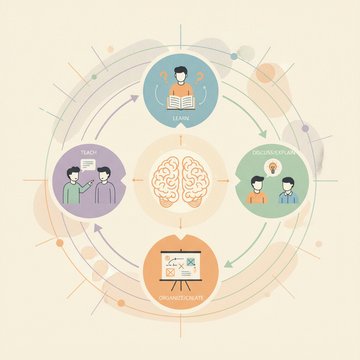


Teaching someone else forces you to retrieve, organize, and simplify what you know, which is exactly why it works so well as a study method. When you explain a concept out loud to another person, you can't hide behind vague familiarity: you either understand it well enough to make it clear, or you hit a wall that shows you exactly what to review. That gap-spotting effect, combined with the mental effort of pulling information from memory, is what makes learning by teaching one of the most effective (and most overlooked) ways to actually lock knowledge in.
Content Table
Why teaching makes you learn
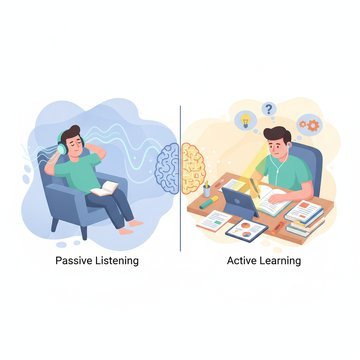
Reading a chapter feels productive, but it's passive. Teaching is the opposite. To explain something, your brain has to do several demanding things at once:
- Retrieve the information from memory instead of just recognizing it on a page. This is active recall in its purest form, and retrieval practice is one of the most reliable ways to strengthen memory.
- Organize scattered facts into a logical order so your listener can follow. A messy mental model can't survive being spoken out loud.
- Translate jargon into plain language, which forces you to actually understand terms rather than parrot them.
- Anticipate questions, which pushes you to think about the edges of a topic, not just the center.
Contrast that with rereading, which often produces the illusion of fluency: the material feels familiar, so you assume you know it. Teaching strips that illusion away fast, because the moment you stumble mid-explanation, you've found a real gap.
The protege effect explained
Researchers have a name for this: the protege effect. Studies have found that students who prepare to teach material, or who actually tutor a peer, learn it more deeply than students who study the same material just to take a test. The expectation of teaching changes how you study in the first place. You read more carefully, you look for the "why" behind facts, and you build connections instead of memorizing in isolation.
Some of the most cited work here comes from research on learning by teaching and "teachable agent" experiments, where students taught a computer character and improved their own understanding in the process. The takeaway is consistent: the act of preparing to explain something to someone else raises the quality of your own learning before you even open your mouth.
Part of why this sticks is metacognition, your awareness of what you do and don't know. Teaching is a constant metacognitive check. If you want to understand that mechanism better, here's what metacognition actually does to your learning.
How to use learning by teaching
You don't need a classroom. Here's how to turn teaching into a repeatable study habit:
- Pick one concept, not a whole chapter. Explaining "how photosynthesis converts light into energy" beats trying to teach all of biology at once.
- Explain it out loud, from memory, in plain words. Pretend your listener knows nothing about the subject. If you have to invent an analogy, even better.
- Watch for where you slow down or hedge. Phrases like "and then somehow" or "this is related to that thing" mark the exact spots you don't really understand.
- Go back and fill those gaps, then explain the whole thing again cleanly.
- Invite questions. A real listener who asks "but why?" is doing you a favor. This is close to elaborative interrogation, where asking "why" deepens understanding.
Peer teaching works especially well when you swap topics with a study partner. Each person becomes the expert on their piece and teaches the other. You also get the bonus of transfer of learning when explaining one topic sharpens skills you can reuse elsewhere.
What if you have no one to teach
Most of the benefit comes from the act of explaining, not from having a live audience. If you're studying alone, try one of these:
| Method | How it works |
|---|---|
| The Feynman technique | Write an explanation as if for a 12-year-old, then simplify anything that sounds complicated. |
| Teach an empty chair | Explain the topic out loud to an imaginary student. Speaking (not thinking) exposes gaps. |
| Record yourself | Explain into your phone, then listen back and note where you were fuzzy. |
| Write a mini lesson | Draft a short blog post or set of notes teaching the concept from scratch. |
Explaining aloud or in writing still triggers the generation effect and forces retrieval. The imaginary student is enough to make your brain do the real work.
Common mistakes to avoid
- Reading your notes while you "teach." That's just rereading with extra steps. Explain from memory or the effect disappears.
- Choosing topics you already know cold. Teaching is most useful on the shaky, half-understood material, which is uncomfortable but that's the point. This kind of productive struggle is a desirable difficulty.
- Skipping the gap-filling step. Finding a hole in your knowledge only helps if you go back and patch it, then re-explain.
- Teaching once and stopping. Spacing your teaching sessions out over days beats one long cram session, since forgetting curves are steep. Here's why you forget things so quickly after studying.
Do it right and teaching becomes a diagnostic tool and a study method at the same time. Every explanation tells you both what you know and what to review next.

Turn your notes into something you can teach
Upload your study material and pull out the key concepts you need to explain out loud, so learning by teaching becomes quick to prep instead of a chore.
Turn your documents into study material →
Yes. Research on the protege effect shows students who prepare to teach or actually tutor peers understand material more deeply than those studying only to be tested. Teaching forces active recall, organization, and simplification, which build stronger, longer-lasting memories than passive rereading.
The protege effect is the finding that teaching material to someone else improves your own understanding of it. Just expecting to teach makes you study more carefully, and the act of explaining reveals gaps in your knowledge that passive review would have hidden.
Absolutely. Most of the benefit comes from explaining, not from a live audience. Try the Feynman technique, teach an empty chair out loud, record yourself explaining, or write a short lesson. Each one triggers retrieval and exposes the spots where your understanding is fuzzy.
Rereading feels familiar, which creates the illusion that you know the material. Teaching requires you to pull information from memory and put it in order without looking. That effort strengthens memory and instantly shows you what you can't yet explain, something rereading never does.
The Feynman technique is writing out a concept in the simplest possible language, as if teaching a child. Whenever you rely on jargon or get stuck, you go back to the source, learn that piece, and simplify again until the whole explanation is clear and plain.