




You forget things so quickly after studying because your brain treats new information as disposable unless you give it a reason to keep it. Most forgetting happens in the first hours and days after learning, especially when you studied by passively reading instead of actively pulling the information back out. This rapid drop is normal, it is called the forgetting curve, and the good news is that your study method has a huge effect on how much sticks.
Content Table
Why Do I Forget Things So Quickly?
Forgetting is not a bug in your brain. It is a feature. Your brain is flooded with information every second, and holding onto all of it would be overwhelming and useless. So it filters aggressively, keeping only what looks important and dumping the rest.
When you study something once and then forget it an hour later, your brain has quietly decided that information was not worth the storage cost. It never got a signal that the material mattered. A few things usually explain why forgetting hits so fast:
- Weak encoding: The information barely made it into memory in the first place, so there is almost nothing to hold onto.
- No retrieval: You read it but never tried to recall it, and recall is what tells your brain "keep this."
- No review: A single exposure fades fast. Memory needs to be revisited to stay.
- Competing information: New material bumps into old material, and the two interfere with each other.
Short term memory loss after studying is not a sign something is wrong with you. It is what happens when learning stays shallow.
What Is the Forgetting Curve?
The forgetting curve is a graph that shows how quickly memory fades over time when you do nothing to reinforce it. It was first described in the 1880s by German psychologist Hermann Ebbinghaus , who ran experiments on himself using nonsense syllables to measure raw memory decay.
What he found is a little brutal:
- About half of what he learned was gone within an hour.
- About two thirds was gone after a day.
- The drop is steepest right after learning, then it flattens out.
There is one caveat. Ebbinghaus memorized nonsense syllables on purpose, so nothing he learned connected to anything he already knew. Material you actually understand fades more slowly, but without review it still follows the same downward curve.
The important part is what the curve looks like after you review. Each time you go back and actively recall the material, the curve resets higher and the forgetting slows down. Review it a few times over spaced intervals and the same information that vanished in a day can last for weeks or months. Ebbinghaus basically proved that forgetting is predictable, and because it is predictable, it is beatable.
What Are the Causes of Forgetting?
Forgetting is not one single thing. Several separate mechanisms cause the material you studied to slip away, and they often stack on top of each other.
| Cause | What happens |
|---|---|
| Weak encoding | You didn't process the material deeply, so the memory formed poorly and had nothing solid to attach to. |
| Memory decay | Memories that go unused fade over time. Without reactivation, the trace weakens on its own. |
| Interference | Similar information competes. New facts overwrite old ones, or old habits block new ones. |
| Retrieval failure | The memory is still there but you can't find it. The cue you need to unlock it is missing. |
| Lack of review | A single exposure isn't enough. Without spaced revisits, retention stays low. |
Weak encoding is the one most students underestimate. If your mind wandered while you were reading, the information never really landed, which is why staying present matters so much. If you struggle with a wandering mind, learning how to keep your focus while studying fixes the problem at the source, before the forgetting curve even starts.
Retrieval failure is the sneaky one. The knowledge is often not truly gone, it is just buried without a path back to it. This is why the right cue, or even the same environment where you learned something, can suddenly bring a memory back. The connection between context and recall is explored more in why your study location affects what you remember .
How Does Passive Reading Affect Memory Retention?
Passive reading is when you move your eyes across the page, maybe highlight a few lines, and feel like you are learning, but your brain is mostly along for the ride. You are recognizing words, not building memory. It is the single most common reason students forget things quickly.
Here is the trap: rereading feels productive. The material gets more familiar each pass, and that familiarity tricks you into thinking you know it. You don't. You just recognize it. This gap between feeling like you know something and actually being able to recall it is called the illusion of fluency , and it fools even smart, hardworking people.
Why passive reading fails at memory:
- No effort, no signal: Recall takes effort, and that effort is exactly what tells your brain the material is worth keeping. Reading skips it.
- Recognition is not recall: Seeing an answer and knowing it are different skills. Exams test recall.
- Shallow processing: Your eyes can finish a paragraph while your mind absorbs nothing.
- False confidence: Fluency feels like mastery, so you stop studying too early.
The fix is to make learning active. Instead of rereading, close the book and try to explain the idea from memory, quiz yourself, or write out what you remember. Producing the answer yourself builds a far stronger memory than seeing it again, an effect covered in why creating your own explanations sticks . Anything that forces retrieval turns passive reading into real, durable learning.
How to Stop Forgetting What You Study
You cannot switch off the forgetting curve, but three habits flatten it a lot:
- Review on a spaced schedule: Go back over the material about 1 day, 3 days, 1 week and 1 month after you first learn it. Each review catches the memory just as it starts to fade, which is why spaced repetition works so well. Eduloo's flashcards schedule these reviews for you.
- Test yourself instead of rereading: Pulling an answer from memory strengthens it far more than seeing it again. A quick practice quiz shows you what you can actually recall and what you only recognize.
- Sleep after studying: Your brain consolidates new memories while you sleep, so cutting sleep throws away part of what you studied. Read more about how lack of sleep affects memory .
Stop forgetting things so quickly after studying
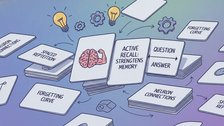
Flashcards force active recall instead of passive reading, so the material you study actually beats the forgetting curve and sticks in memory.
Create your flashcards →
We forget because the brain discards information it decides isn't important. Without review or active recall, a memory decays fast, following the forgetting curve. Weak encoding, interference from similar material, and a single passive exposure all speed up how quickly learned things fade away.
This is usually a temporary retrieval failure, not memory loss. The word is stored but your brain briefly can't reach the cue to unlock it. Stress, tiredness, distraction, and doing too much at once all overload working memory and make these mid sentence blanks more likely.
A fleeting thought lives in working memory, which holds only a few items for a few seconds. If you get distracted before rehearsing or writing it down, it never transfers to longer term storage and disappears instantly. Capturing thoughts quickly is the reliable fix.
Memory is reconstructive, not a recording. Each time you recall something, your brain rebuilds it and can mix in details from imagination, suggestion, or other events. These false memories feel completely real because your brain treats the reconstructed version as the original.
Usually it means your study or lifestyle habits, not your brain, are the issue. Passive reading, poor sleep, stress, and lack of review all cause everyday forgetting. It is normal. If forgetting is sudden, severe, or affects daily function, it is worth talking to a doctor.
Working memory is your brain's short term workspace that holds and manipulates a small amount of information right now, like a phone number you're about to dial. It has limited capacity and fades in seconds unless you actively rehearse or transfer the information into longer term memory.
That nagging feeling comes from a partial memory cue firing without the full memory attached. Your brain senses an unfinished task or an incomplete thought but can't retrieve the details. It often happens during busy, high stress stretches when many small intentions compete for attention.