


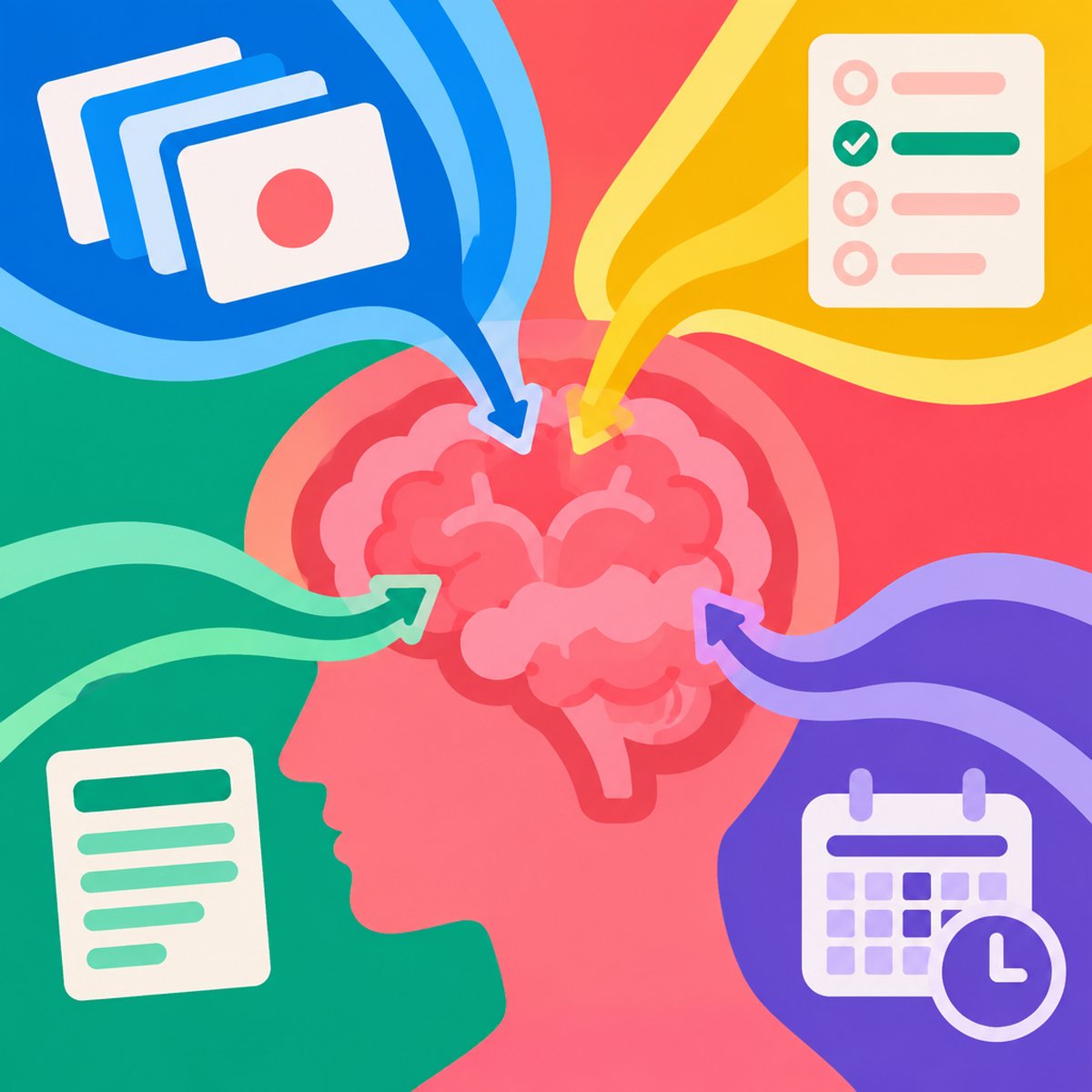

Metacognition is your ability to think about your own thinking, and when you apply it to studying, it turns you from a passive reader into an active manager of your own learning. In practice, metacognition and learning are tightly linked: students who plan how they'll study, monitor whether they actually understand something, and adjust their approach when it isn't working consistently outperform students who just put in hours. It's the difference between "I read the chapter" and "I read the chapter, quizzed myself, found three gaps, and reread only those parts."
Content Table
What metacognition actually means
The word breaks into two parts: "meta" (above or beyond) and "cognition" (thinking). So metacognition is thinking that sits above your regular thinking, watching it and steering it. Psychologist John Flavell coined the term in the 1970s, and researchers usually split it into two pieces:
- Metacognitive knowledge — what you know about how you learn. For example, knowing you remember diagrams better than paragraphs, or that you focus best in 25-minute blocks.
- Metacognitive regulation — what you actually do with that knowledge: planning, monitoring your progress, and evaluating results afterward.
Knowledge without regulation is useless. Plenty of students know they study better in the morning and then cram at midnight anyway. The payoff comes when the knowledge changes the behavior.
What it does to your learning
Metacognition doesn't add new facts to your brain. It makes the facts you're trying to learn stick faster and stay longer by fixing the single biggest problem in studying: not knowing what you don't know.
Here's what changes when you apply it:
- You catch gaps early. Instead of discovering on the exam that you never really understood a concept, self-testing exposes the gap while there's still time to fix it.
- You stop wasting time on stuff you already know. Monitoring tells you which topics are solid so you can redirect effort to the shaky ones.
- You break the rereading trap. Passively rereading notes feels productive but mostly builds the illusion of fluency, where familiar text tricks you into thinking you've mastered it. Metacognition forces the honest test: can I explain this without looking?
This whole loop is the engine behind self-regulated learning, where you set goals, track progress, and correct course on your own rather than waiting for a teacher to tell you where you stand.
Metacognitive strategies that work
These are concrete metacognitive strategies you can start using this week. They map onto the three phases of self-regulated learning: before, during, and after.
| Phase | Strategy | What it looks like |
|---|---|---|
| Before (Plan) | Set a goal and predict difficulty | "I'll master photosynthesis in 40 minutes. The light reactions will be the hardest part." |
| During (Monitor) | Self-question and self-test | Pause every few minutes and ask "Could I explain this out loud right now?" |
| After (Evaluate) | Review what worked | "Flashcards helped, but I still confused two terms, I'll add examples next time." |
A few of these deserve a closer look:
- Ask yourself "why." When you meet a new fact, force yourself to explain why it's true rather than just accepting it. This technique, called elaborative interrogation, deepens understanding and doubles as a monitoring check: if you can't answer "why," you've found a gap.
- Explain it in your own words. Generating your own explanation instead of copying one forces active processing and reveals exactly where your understanding breaks down.
- Predict your quiz score. Before testing yourself, guess how many you'll get right. The gap between prediction and reality is pure metacognitive feedback, and it shrinks as your self-awareness improves.
Where students go wrong
Even motivated students sabotage their metacognition without realizing it. Watch for these:
- Confusing familiarity with mastery. Seeing a term you recognize feels like knowing it. Recognition and recall are not the same skill, and exams test recall.
- Only monitoring, never adjusting. Noticing you don't understand something and then rereading it the exact same way is not metacognition. The point is to change your approach.
- Skipping the evaluation step. Finishing a study session and immediately moving on wastes the most useful data you have: what actually worked.
- Ignoring your physical state. Poor judgment about what you know often traces back to fatigue. Studying while exhausted wrecks both focus and the sleep-driven consolidation that locks learning in overnight.
How to build the habit
Metacognition is a skill, not a personality trait, so it grows with deliberate practice. Start small:
- Add one question to every session. At the end, ask "What did I actually learn, and how do I know?" Answer honestly.
- Test before you review. Try to recall material first, then check. The struggle itself shows you where the gaps are.
- Keep a two-line study log. Note what you studied and one thing you'd change next time. Over a week you'll spot patterns.
- Notice your emotional and physical state. How you feel while studying shapes what you remember, an effect known as state-dependent memory, so track whether stress or fatigue is distorting your judgment.
The goal isn't to overthink every second of studying. It's to build small, honest checkpoints that keep you from fooling yourself. Do that consistently and your study time gets sharper without getting longer.

Turn self-testing into a habit with flashcards
Metacognition and learning depend on catching gaps before the exam does. Our free flashcard tool makes the self-testing and recall practice that powers self-regulated learning effortless to build.
Create your flashcards →
Metacognition is thinking about your own thinking. When studying, it means planning how you'll learn, checking whether you actually understand something as you go, and reviewing what worked afterward. In short, it's being the manager of your own learning instead of just going through the motions.
Studying harder adds more hours, but metacognition adds accuracy. It tells you which topics need work and which don't, so you stop wasting effort on material you already know. The result is smarter study time, not just more of it, which usually beats raw hours spent.
The core strategies follow three phases: planning (set a goal and predict difficulty), monitoring (self-question and self-test as you study), and evaluating (review what worked afterward). Predicting your quiz score and explaining concepts in your own words are two powerful, easy ways to start.
Close your notes and explain the idea out loud or write it from memory. If the explanation stalls, the understanding isn't there yet. That honest check is the core monitoring move in metacognition, and it also exposes the illusion of fluency.
It's a learnable skill, not a fixed trait. Beginners often overestimate what they know, but with practice like predicting scores and keeping a short study log, your self-awareness sharpens quickly. Most people see their predictions get more accurate within a few weeks of deliberate effort.