

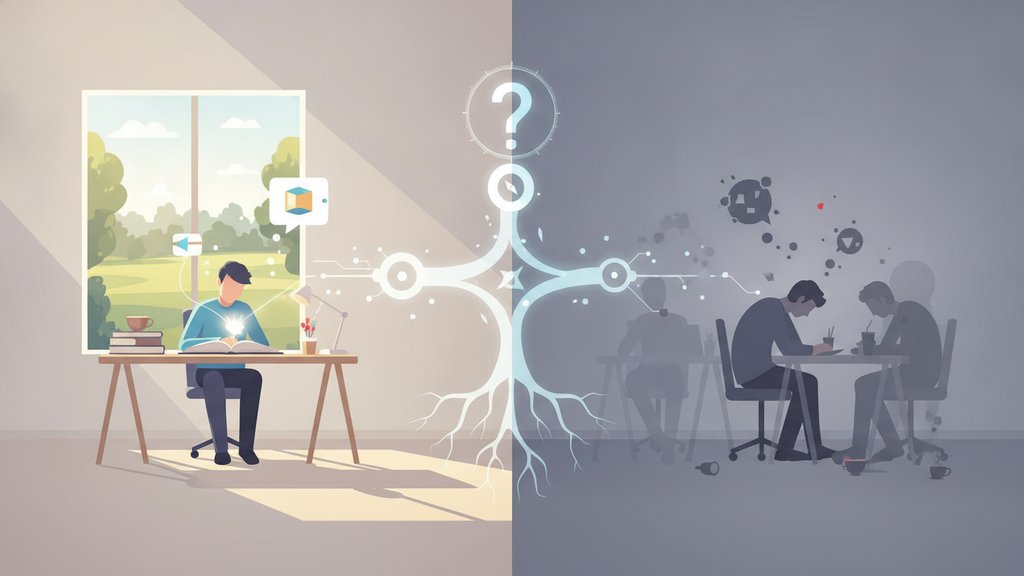
The encoding specificity principle says your memory works best when your recall environment matches the environment where you first learned something. In plain terms: if you study biology in a quiet library, you'll remember more of it in a quiet room than in a noisy cafe, because your brain quietly ties what you learn to where and how you learned it. Those surroundings become retrieval cues that help you pull the information back out later.
This is why your study location isn't just about comfort. The sounds, smells, lighting, and even your posture get bundled together with the actual material, and matching those conditions at test time gives your memory extra hooks to grab onto.
Content Table
What the encoding specificity principle actually means
The principle comes from psychologists Endel Tulving and Donald Thomson, who proposed it in 1973. Their core claim: a memory cue only works if it was encoded along with the information you're trying to recall. You don't just store "the mitochondria is the powerhouse of the cell." You store that fact wrapped in the context surrounding you when you learned it.
Two ideas fall under this umbrella:
- Context dependent memory - your physical surroundings (room, sounds, smells) act as cues.
- State dependent memory - your internal state (mood, alertness, even caffeine level) acts as a cue.
Both are versions of the same idea: memory is a match game. The more the retrieval situation overlaps with the encoding situation, the easier the retrieval. If you're curious about the internal side, we cover how your emotional state while studying affects what you remember in depth.
The famous underwater experiment
The most cited proof is a 1975 study by Godden and Baddeley. They had deep-sea divers memorize lists of words in two settings: on dry land and 20 feet underwater. Then they tested recall in both settings.
| Learned | Recalled | Result |
|---|---|---|
| On land | On land | Best recall |
| Underwater | Underwater | Best recall |
| On land | Underwater | Recall dropped ~40% |
| Underwater | On land | Recall dropped ~40% |
Words learned underwater were recalled far better underwater, and words learned on land came back better on land. The mismatch cost divers roughly 40% of what they'd learned. You can read the original in the British Journal of Psychology.
Why your environment becomes a retrieval cue
Your brain doesn't record facts in isolation. When you encode a memory, it links to whatever your senses are picking up at that moment. That background detail gets stored alongside the target information, even though you never consciously decided to remember it.
Later, encountering those same details reactivates the whole bundle. Walk into the room where you crammed, hear the same playlist, smell the same coffee, and the associated facts get a little nudge toward the surface. This is also why walking into a different room and forgetting why you went there is so common: you left the cues behind.
How to use this when you study
You can't always take the exam in your bedroom, so the trick is to work with the principle instead of against it. A few practical moves:
- Study where you'll be tested when possible. If your exam is in a big quiet hall, do a few sessions in a library rather than only on your couch.
- Vary your study locations. Studying the same material in three different rooms attaches it to multiple contexts, so no single environment becomes a crutch. This makes recall more flexible.
- Rebuild cues mentally. Can't get into the exam room? Picture it while you review. Mentally reinstating context recovers a chunk of the lost recall.
- Keep your internal state steady. If you study caffeinated, test caffeinated, because your internal state is a retrieval cue too.
Pair this with study methods that don't lean on any single cue. Techniques like spaced repetition and smart flashcard use force you to retrieve information cold, in many sittings, which builds memory strong enough to survive a change of scenery. And since a tired brain barely encodes context at all, good sleep after studying locks in what you learned.
When matching location backfires
There's a catch. If you only ever study in one spot, your recall becomes dependent on that spot, and an unfamiliar exam room can hurt you. That's why deliberately varying context is usually smarter than obsessively recreating one perfect environment.
Also, environment cues fade fast for well-consolidated memories. If you've truly mastered material through repeated retrieval, location stops mattering much. Context is a helper for fragile memories, not a substitute for actually knowing the content. And when your surroundings are full of distractions, no amount of cue-matching saves you, so it helps to first sort out why your brain wanders and how to fix it.

Build memory that survives any study environment
The encoding specificity principle means location-locked memories fail in new rooms. Our flashcards make you retrieve answers cold across many sessions, so recall works no matter where you study or test.
Create your flashcards →
No. Matching the exam environment helps, but it isn't required. A better strategy is varying your study locations so the material attaches to several contexts. That way your recall doesn't depend on any single room, which protects you when the actual exam setting is unfamiliar.
Context dependent memory relies on external cues like the room, sounds, or smells around you. State dependent memory relies on internal cues like your mood, alertness, or caffeine level. Both follow the encoding specificity principle: recall improves when the retrieval conditions match the ones present during learning.
Yes. If you study with a specific playlist, hearing it again can nudge memories back. But you won't have that playlist in a silent exam hall, so the cue disappears. Studying in varied audio conditions builds more reliable, cue-independent recall. Whether music helps you concentrate is a different question, covered in how to focus while studying.
You formed the intention in one context, surrounded by cues that supported it. Moving to a new room strips those cues away, so the memory loses its hooks. Returning to the original room often makes the thought pop back, which is the encoding specificity principle in everyday life.
In the classic diver study, a context mismatch cut recall by about 40 percent for freshly learned lists. The effect is largest for weakly learned material. Well-mastered content, built through repeated retrieval and spaced practice, is far less sensitive to where you happen to be.